
MLPPF: A Multi-Layer Privacy-Preserving Framework for High-Dimensional Big Data in Cloud Computing
Article Sidebar
Main Article Content
Abstract
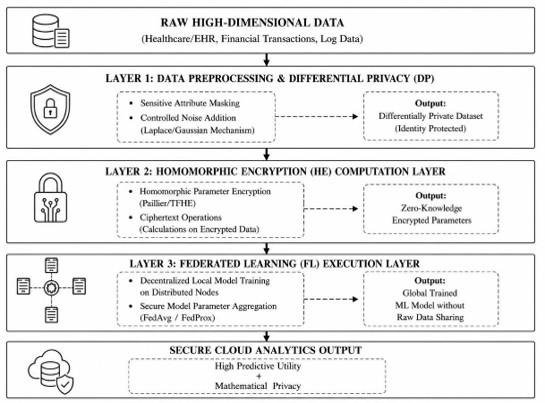
Big Data and Cloud Computing architectures have changed the face of modern data analytics, but they also present serious security risks, risk of unauthorized access, and serious privacy issues during the processing, storage, and transmission of sensitive, high-dimensional data sets. Typical individual privacy preserving techniques, including pure noise addition (Differential Privacy) and computationally demanding cryptographic methods (Homomorphic Encryption), and local decentralized methods (Federated Learning) are often unable to be used individually because of basic compromises between privacy levels, system processing speed and analytical value. To address these single-point structural and vulnerabilities to advanced inference attacks, this thesis introduces a novel comprehensive Multi-Layer Privacy-Preserving Framework (MLPPF) that systematically integrates Differential Privacy (DP), Homomorphic Encryption (HE), and Federated Learning (FL) into a single architecture. The potential benefits of the proposed framework include multiple levels of privacy protection, achieved by implementing differential noise application during data preprocessing, cryptographic security during cross-node computations, and privacy-preserving model aggregation during collaborative execution, along with the reduction of unnecessary communication overhead. The empirical studies have been carefully designed to evaluate the predictive model accuracy, data utility, and operational scalability across a variety of real-world benchmark datasets, ranging from complex medical records to sensitive financial fraud signals to high-frequency transactional logs, among others, and show that the hybrid MLPPF approach consistently maintains high predictive model accuracy, strong data utility, and superior operational scalability with provable mathematical guarantees of privacy against sophisticated adversarial attacks.
Article Details
Section
How to Cite
References
Oh, J.; Son, S.; Kwon, D.; Kim, M.; Park, Y.; Park, Y. Design of Secure and Privacy-Preserving Data Sharing Scheme Based on Key Aggregation and Private Set Intersection in Medical Information System. Mathematics 2024, 12, 1717.
https://doi.org/10.3390/math12111717
Acar, A., Aksu, H., Uluagac, A. S., & Conti, M. (2018). A survey on homomorphic encryption schemes: Theory and implementation. ACM Computing Surveys (CSUR), 51(4), 1-35.
Chen, R., Li, H., Qin, A. K., Kasiviswanathan, S. P., & Jin, H. (2020). Private spatial data aggregation in the local setting. IEEE Transactions on Knowledge and Data Engineering, 32(5), 1007-1020.
Cormode, G., Jha, S., Kulkarni, T., Li, N., Srivastava, D., & Wang, T. (2018). Privacy at scale: Local differential privacy in practice. In Proceedings of the 2018 International Conference on Management of Data (pp. 1655-1658).
Dwork, C., McSherry, F., Nissim, K., & Smith, A. (2006). Calibrating noise to sensitivity in private data analysis. In Theory of cryptography conference (pp. 265-284). Springer, Berlin, Heidelberg.
Dwork, C., & Roth, A. (2014). The algorithmic foundations of differential privacy. Foundations and Trends in Theoretical Computer Science, 9(3-4), 211-407.
Gentry, C. (2010). Computing arbitrary functions of encrypted data. Communications of the ACM, 53(3), 97-105.
Jain, P., Gyanchandani, M., & Khare, N. (2016). Big data privacy: a technological perspective and review. Journal of Big Data, 3(1), 1-25.
Konečný, J., McMahan, H. B., Yu, F. X., Richtárik, P., Suresh, A. T., & Bacon, D. (2016). Federated learning: Strategies for improving communication efficiency. arXiv preprint arXiv:1610.05492.
Lee, J., & Clifton, C. (2011). How much is enough? choosing ε for differential privacy. In International Conference on Information Security (pp. 325-340). Springer, Berlin, Heidelberg.
Li, N., Lyu, M., Su, D., & Yang, W. (2016). Differential privacy: From theory to practice. Synthesis Lectures on Information Security, Privacy, & Trust, 8(4), 1-138.
Li, Q., Wen, Z., Wu, Z., Hu, S., Wang, N., Li, Y., ... & He, B. (2019). A survey on federated learning systems: vision, hype and reality for data privacy and protection. arXiv preprint arXiv:1907.09693.
Li, T., Sahu, A. K., Talwalkar, A., & Smith, V. (2020). Federated learning: Challenges, methods, and future directions. IEEE Signal Processing Magazine, 37(3), 50-60.
Liu, C., Chen, X., Xia, R., Liu, L., & Chen, L. (2019). PrivFL: A privacy-preserving federated learning framework for big data. In 2019 IEEE International Conference on Big Data (Big Data) (pp. 2587-2596). IEEE.
Liu, Y., Chen, Y., Gao, J., Gong, Y., & Wen, Y. (2020). Privacy-preserving outlier detection for distributed big data. IEEE Transactions on Big Data, 6(3), 501-513.
McMahan, H. B., Moore, E., Ramage, D., & Aguera y Arcas, B. (2017). Communication-efficient learning of deep networks from decentralized data. In Artificial Intelligence and Statistics (pp. 1273-1282). PMLR.
Wang, H., Xu, Z., & Fujita, H. (2017). Improving the privacy-preserving distributed k-means clustering for vertically partitioned datasets. Knowledge-Based Systems, 122, 1-1 Jain, P., Gyanchandani, M., & Khare, N. (2016). Big data privacy: a technological perspective and review. Journal of big data, 3(1), 25.
Zhang, J., Sun, J., Zhang, R., Zhang, Y., & Hu, X. (2018, April). Privacy-preserving social media data outsourcing. In IEEE INFOCOM 2018-IEEE conference on computer communications (pp. 1106-1114). IEEE.
Al-Mayahiyah, S. Y. (2019). A Comprehensive Approach to Privacy Preserving Data Publishing in Cloud Computing (Doctoral dissertation, Sultan Qaboos University).
Sun, L., Qian, J., & Chen, X. (2020). LDP-FL: Practical private aggregation in federated learning with local differential privacy. arXiv preprint arXiv:2007.15789.
Li, S., Zhao, S., Min, G., Qi, L., & Liu, G. (2021). Lightweight privacy-preserving scheme using homomorphic encryption in industrial internet of things. IEEE Internet of Things Journal, 9(16), 14542-14550.
Wang, Y., Han, Y., Bao, H., Shen, Y., Ma, F., Li, J., & Zhang, X. (2020). Privacy-preserving federated learning with differential privacy in mobile edge computing. In 2020 IEEE Wireless Communications and Networking Conference (WCNC) (pp. 1-6). IEEE.
Wood, A., Najarian, K., & Kahrobaei, D. (2019). Homomorphic encryption for machine learning in medicine and bioinformatics. ACM Computing Surveys (CSUR), 53(4), 1-35.
Yang, Q., Liu, Y., Chen, T., & Tong, Y. (2019). Federated machine learning: Concept and applications. ACM Transactions on Intelligent Systems and Technology (TIST), 10(2), 1-19.
Zhao, Y., Li, M., Lai, L., Suda, N., Civin, D., & Chandra, V. (2018). Federated learning with non-iid data. arXiv preprint arXiv:1806.00582.